

Find Your Gearbox
At Trailer Gearbox, we know trailers. We have owned, maintained, and worked with hundreds of trailers across real hauling, equipment, and trailer-based businesses. We built Trailer Gearbox because we saw the same problem over and over again: hand-cranking a trailer jack SUCKS! It is slow, frustrating, and physically demanding.
Whether you are hooking up in bad weather, raising a loaded gooseneck trailer, leveling an equipment trailer, or trying to avoid unnecessary strain on your shoulders and back, the right drill-powered trailer gearbox can make the job significantly easier.
This guide will help you choose the correct Trailer Gearbox system for your trailer jack configuration, mounting style, and application, so you can buy with confidence and get the right fit the first time.
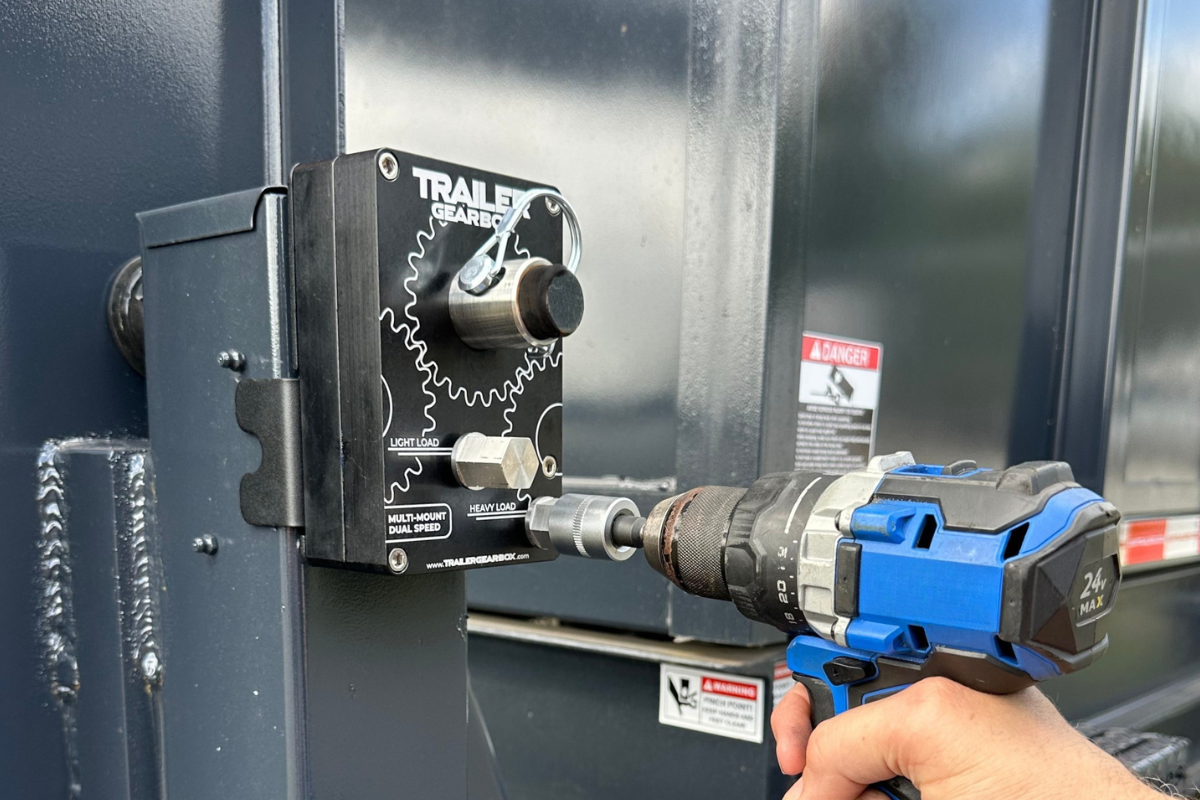
What are Trailer Gearboxes?
Gearboxes are designed to fit on standard heavy duty trailer jacks with a 1" round handle shaft. Sometimes refered to as trailer landing gear or trailer legs, these usually have an S shaped handle pipe handle attached to them. Some applications may have a hex shape or cross pin interface on the handle. Most of these jacks are 4 inches square and welded to the trailer, though in heavy trailers they may be even larger. We offer a selection of accessories to adapt to your setup. Our Trailer Gearboxes replace the manual cranking of your handle with a gearbox that uses gear reduction to allow you to rasie and lower your trailer with a cordless drill.
Applications

Dump Trailers
Raise, lower, and reposition dump trailers faster with a drill-powered trailer gearbox mounted on your jack. Ideal for owners, rental fleets, and operators who want less manual cranking and easier trailer handling.

Equipment Trailers
Make equipment trailer hookup, leveling, and repositioning faster with a drill-powered trailer gearbox that mounts to your jack. Built for contractors, rental fleets, and operators hauling skid steers, tractors, and jobsite equipment.

Stock Trailers
Speed up stock trailer hookups at the farm, ranch, or sale barn with a drill-powered trailer gearbox that mounts to your jack. A practical upgrade for livestock haulers who want easier trailer handling without constant hand cranking

Enclosed Trailer
Make enclosed trailer hookups faster and easier with a drill-powered trailer gearbox that mounts to your jack. Ideal for cargo trailers, contractor trailers, and mobile business setups where quick, low-effort trailer handling matters.
Configurations

Single Jack - Free Standing
Free-standing 4" single jacks with a horizontal shaft are commonly used on heavy-duty bumper pull trailers. This setup is one of the simplest Trailer Gearbox installations: remove the manual crank handle, slide the correct drill-powered trailer GEARBOX onto the jack shaft, secure it with the included standard bracket and snap pin, and you’re ready to operate your trailer jack with a cordless drill.

Single Jack - AgainsT Panel
Single 4" horizontal-shaft jacks mounted against a front panel are commonly found on gooseneck enclosed trailers, stock trailers, and horse trailers. This setup usually has two Trailer Gearbox installation options depending on how the jack handle and extension shaft are arranged.
At the Jack:
Option 1: Remove the handle and extension shaft, then mount the GEARBOX directly to the jack using the included standard bracket.
Option 2: If the Jack is mounted flat against the trailer brace and does not allow a standard bracket, an OVER/UNDER BRACKET may be used to brace the gearbox.
At the Handle:
Option 1: For a quick and versatile install, remove the handle from the extension shaft, install the GEARBOX using a HANDLE BRACKET, then slide the gearbox onto the extension shaft and pin it in place.
Option 2: For a purpose built install, and a 1/2" hole above or below your jack shaft and install your GEARBOX with a PIN BRACKET. The pin slides into the hole in your panel and prevents rotation.

Dual Jack - External
Externally mounted dual jacks are one of the most common jack configurations found on gooseneck trailers. “External” means the jack bodies are visible and accessible on the outside of the trailer, rather than hidden behind a stanchion, panel, or enclosure.
Because the jack body is easy to access, installation is usually straightforward: remove the existing handle, slide the Trailer GEARBOX onto the jack shaft with the included standard bracket installed, and secure it with the snap pin. The factory connecting rod between the two jacks will run both simultaneously as usual.
Bracket Note: If your jack body is welded flat against the trailer and there is not enough clearance for the standard bracket leg to wrap around the jack, you can remove the standard bracket and run the gearbox without it. In this setup, the close fit against the trailer panel acts as the anti-rotation support and keeps the gearbox from turning while in use.

Dual Jack - Internal
Internally mounted jacks are less common and usually found on older trailers. “Internal” means that the jacks are hidden behind a stanchion, panel, or enclosure, and generally not accesible.
Because the jack body is not accessible, an accessory bracket is usually required.
Option 1: For a quick and versatile install, remove the handle from the extension shaft, install the GEARBOX using a HANDLE BRACKET, then slide the gearbox onto the extension shaft and pin it in place.
Option 2: For a No-Modification dedicated bracket, Install the GEARBOX with an OVER/UNDER bracket using the adjustable top and bottom tabs to interface with the stanchion of your trailer.
Option 3: For a purpose built install, and a 1/2" hole above or below your jack shaft and install your GEARBOX with a PIN BRACKET. The pin slides into the hole in your panel and prevents rotation.
Frequetly Asked Questions
What Kind of Drill do I need? Can I use an Impact?
What Kind of Drill do I need? Can I use an Impact?
We recommend using an 18v or larger cordless DRILL, and setting your clutch to the highest setting. This prevents unexpected kickback or damaging your jack or gearbox in the event you bottom out your jack to the end of travel.
For most general purposes a 2ah Capacity is plenty for multiple up and down cycles. If you plan to go long periods between charges or load/unload very heavy trailers frequently throughout the day a larger amp hour battery will give you more runtime.
WE DO NOT RECOMEND USING AN IMPACT OR IMPACT DRIVER ON YOUR GEARBOX! Impacts are designed to transmit extreme shock loads to what they are driving in order to break things free or drive them home. While that impact is adverse to your gearbox, it is also being transmitted to the internals of your jack that was never designed to hold up to that kind of stress. A cordless drill delivers smooth controlled torque, that is multiplied by your gearbox and safely delivered to your jack.
How much weight can it lift?
How much weight can it lift?
Generally speaking, your gearbox is replacing you as the source of power for cranking your trailer jack. A good rule of thumb is if an able bodied person can crank the handle manually, a Trailer Gearbox can as well.
The Multi-mount product line is rated at 8,000lbs of tongue weight.
The Supermax product line is rated at 10,000lbs of tongue weight.
Will the gearbox work with Dual Jacks?
Will the gearbox work with Dual Jacks?
Absolutely. Your gearbox simply replaces the existing single handle on your dual jack setup. The gearbox rotates the input shaft of your jack and in turn, the connecting rod between them raising both jacks simultaneously just as your handle would.
Single Speed Vs. Dual Speed?
Single Speed Vs. Dual Speed?
Some gearbox models offer a Single Speed and a Dual Speed option.
Single Speed: These gearboxes have one drive input and operate at the maximum gear reduction at all time. That means you are always getting the most torque output, but at the sacrifice of speed. For most casual users this is never an issue, but in instances where there is a need to run the trailer legs up or down a long distance each time, a Dual Speed offers more options.
Dual Speed: These gearboxes have two drive inputs, Heavy Load and Light Load. The Heavy Load input is identical to the Single Speed input, giving maximum torque at the output at a lower speed. This should always be used once your jack begins physically lifting your trailer. The Light Load input uses a reduced gear ratio, this allows your jack to travel much faster, and is intended for running your jack legs down to the ground long distances or lowering your trailer quickly. When your ready to raise your trailer simply swap your drill to the Heavy Load input.
Note: Light Load input may be used to raise an empty trailer, depending on unloaded tongue weight. Test slowly, looking for extreme drill load before using regularly.
Dont spend another day cranking!

Made in the USA
Proudly Designed, Built & Tested
In The United States

Simple Returns
If It’s Not Right, We’ll Make
It Right –– Guaranteed

Real Human Support
Talk To A Team That Actually
Uses The Product

Built For Real Work
Trusted by Haulers, Pros, and
Weekend Warriors Alike
- Choosing a selection results in a full page refresh.
- Opens in a new window.